To Follow Click The Button Below

Showing posts with label Blink. Show all posts

Wednesday, March 9, 2022

Wednesday Bonus - Blink


Amazon - Blink

If you have Textbooks you would like to sell check this website out.  I highly recommend them.  They even pay for the shipping.  I will get a small commission if you use the above link and it will not cost you anything.

My regular Wednesday post was posted previous to this.  This is just an added bonus for today.

The introduction of the book starts with The Getty  Museum in Cali deciding on whether to buy a kouros, a Greek sculpture from 6th century BC in unbroken condition.  It had all the paperwork.  They were given lots of time to make their decision and get expert opinion.  After 14 months they bought it.  Afterwards some people on first sight just thought it didn’t look right.  Gut feeling stuff.  They were correct.  You can read about this by clicking here.


The first chapter dealt mostly with a University of Washington  psychologist named John Gottman who studied married couples.  He would video tape couples having a 15 minute conversation about anything in their marriage that was contentious.  Every second of the video was coded along 20 different categories.    From this he has a 90% success rate of telling whether the couple is still married in 15 years.  The chapter talks about “thin slices”.  For example if Gottman is out for dinner and eavesdrops a conversation and hears one partner showing contempt for the other you can put a fork in that marriage.


The second chapter talks about Vic Braden who is a world class tennis coach.  He can call a pro’s double fault almost 100% of the time but doesn’t know why.  The next thing on snap decisions was about speed dating.  Yes that was a thing  at the beginning of the millennium.


The third chapter deals with when you F#ck up by”thin slicing”.   The first bit was about Warren Harding, the worst US and A president at the time of the book writing.  We all know it is really t-rump.  Shut your cake hole you trumpanzees.   Then he talks about the Implicit  Association Test.  Take it for kicks at  https://implicit.harvard.edu/ .  He uses this to explain why most Fortune 500 CEOs are over 6 foot tall.  Finally he talks about car salesman.  


The fourth chapter starts with US Military‘S Joint Force Command or JFCOM and their war games in the summer of 2002. After desert storm the Pentagon figured war would not be waged as it was then.  They set up a mock battle for 2.5 weeks.  It cost a quarter billion dollars.  The government or blue team was able to analyze or over analyze everything the enemy or red team did.  Retired Paul Van Riper had a long distinguished military career was in charge of the red team or the militants.   Paul did not behave as the blue teams computer modelled.  The short of it is that Paul did not over analyze everything and the government did.  Guess which team won?  You guessed it.  


The second half of the chapter dealt with Cook County Hospital in Chicago.  It was a public hospital and had little money.  It’s biggest expense was the Emergency Department and how to deal with heart attacks.  It seems doctors try and get as much information on their patients as possible.  However it seems with this much info almost everyone needs to be admitted.  The new  chairman realized there needed to be a better way.  He eventually used an algorithm based on 3 yes or no questions and an ECG.  It turned out 70% better than just what the docs thought.  They over analyzed everything.  


The fifth chapter dealt with singer Kenna.  He was loved by all music execs that saw him but when  it was given to outside market research it did not do well.  Put vid in.  It dealt with New Coke as the old Coke was losing blind taste tests to Pepsi that were just sips.  Show commercial.  Also in this chapter was the new Areon ergonomic office chair that every office has now but not at that time as initially it was thought to be a monstrosity.   Put pic in.  Since these things and others in this chapter are very radical the situation was different then just “thin slicing”.   It even explains margarine acceptance.


The sixth chapter deals with how when police thin slice and get things wrong and what can be done about it.  He spends quite a bit of time on research into reading peoples facial expressions.  Then he spends time on how this relates to autism.  


The concluding chapter concludes with reference to professional symphonies and orchestras using a blind when having tryouts.  When this started happening you guessed women started getting hired.


Another good read by Gladwell.  My Song of the Day and rant that putin sucks is in my previous post.  This is just Bone Ass.


Saturday, January 15, 2022

What The Dog Saw - Part 3


Amazon - What the Dog Saw

If you have Textbooks you would like to sell check this website out.  I highly recommend them.  They even pay for the shipping.  I will get a small commission if you use the above link and it will not cost you anything.

Canadian University Students - Get Your 6 Month Free Trial Prime Student Account Here

My summary of Malcolm Gladwell's book What The Dog Saw is being done in three parts over three days.  Here is my write up of the third part of his book.


Part Three

The fourteenth chapter is called Late Bloomers.  It is about authors and painters  that are not prodigious but must spend much of their career honing their craft.  He uses Cezanne as an example. 

Most Likely to Succeed is the fifteenth chapter and it discusses the hardship in selecting NFL quarterbacks based on their college history and that of selecting top notch teachers.  I think they are both similar.  Wink.  Wink.

The sixteenth chapter is called Dangerous Minds and deals with trying to identify serial killers by the crime scene or notes that are sent to the authorities.

The Talent Myth is the seventeenth chapter.  It deals with highly touted MBA’s from top end business schools like Wharton.  It focussed a bit on Enron too.

The eighteenth chapter The New-Boy Network asks the question “What do job interviews really tell us?”  We it comes right down to it, if it is a classical interview the first 15 seconds are all that matters.  First impressions are everything.  After that your answers will confirm the interviewers initial thoughts pretty much no matter what.  Speak clearly and smile.  😀

Friday, January 14, 2022

What The Dog Saw - Part 2


Amazon - What the Dog Saw

If you have Textbooks you would like to sell check this website out.  I highly recommend them.  They even pay for the shipping.  I will get a small commission if you use the above link and it will not cost you anything.

Canadian University Students - Get Your 6 Month Free Trial Prime Student Account Here

My summary of Malcolm Gladwell's book What The Dog Saw is being done in three parts over three days.  Here is my write up of the second part of his book.

Part Two

The seventh chapter deals with the now defunct energy company, Enron.  It details how almost all of the info needed to to know it was vulnerable financially were in its quarterly filings but there was just lots and lots of minutia to sift through.  It was hidden in plane site.

The eighth chapter is called  Million - Dollar Murray.  Many things in behavioral science obey a Gaussian Distribution or bell curve.  For example in first year psych most students will be fairly near the average with less near the extremes, zero and perfect.  This chapter deals with behavior   where the outliers might still might be extreme but cause most of the problems and Gladwell calls this Power Law distribution.  He uses examples of homelessness.  Of all the homeless people in Reno only a handful are in the hospital so much (due to severe inebriation) that their public funded yearly hospital bill is close to 100k.  This is staggering considering this is a 15 year old book.  He suggests that just helping out these chronics would save the tax payers millions.  He uses another example of car emissions in Denver where a small percentage of cars produce most of the toxic emissions yet all older cars are subject to testing.  Again just going after the outliers with technology would solve the problem.   He also talks about this with the policing issues with the LAPD.  A great chapter.  “ power law solutions have a little appeal to the right, because they have all special treatment for people who do not deserve special treatment and have little appeal to the left, because their emphasis on efficiency over fairness suggest the cold number crunching of Chicago school cost benefit analysis. Even the promise of millions of dollars in savings or cleaner air or better police departments cannot entirely  compensate for such discomfort.”

The ninth chapter is called the picture problem.  It had much to do with WW 2 photo recon, the Gulf War Satellite recon and mammogram and mammography.

The tenth chapter is called Something Borrowed and deals with plagiarism and intellectual property rights.  A play on Broadway actually used some of Gladwell’s work and he was not accredited with it.  There is mention of music such as  Nirvana’s Smells Like Teen Spirit and the guitar lick from Boston’s More Than a Feeling.

The eleventh chapter dealt with intelligence reform such as after 9/11 or other bombings .  In retrospect if you just look at selected evidence it is easy to say why couldn’t intelligence agencies just connect the dots but it is never that easy as there is always so much noise.

The twelfth chapter is  called The Art of Failure.  It deals with the difference between choking and panicking.  It concludes with Greg Norman’s epic choke to Nick Faldo at the 96 Masters.

Blowup is the thirteenth chapter and mostly deals with the Challenger explosion of 1986 and a bit of the Three Mile Island near nuclear meltdown of 1979.  He brings up that “ under certain circumstances, changes that appear to make a system or an organization safer in fact don’t. Why? Because human beings have fundamental tendency to compensate for less risk in one area by taking greater risk in another.”  He gives as examples that more people get hit by cars crossing the street at cross walks than not because we let down our guard there.  Similarly when childproof lids were put on medicine bottles, it lead to increased child poisoning because people became less vigilant about keeping pill bottles out of the reach of kids.

Thursday, January 13, 2022

What The Dog Saw - Part One


Amazon - What the Dog Saw

If you have Textbooks you would like to sell check this website out.  I highly recommend them.  They even pay for the shipping.  I will get a small commission if you use the above link and it will not cost you anything.

Canadian University Students - Get Your 6 Month Free Trial Prime Student Account Here

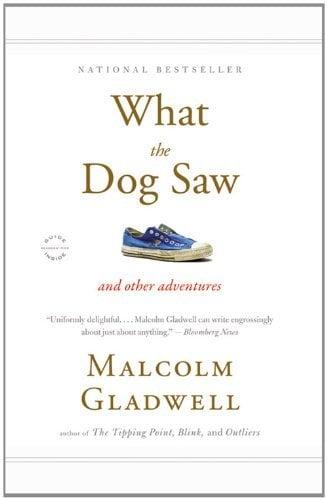
I love all of Malcolm Gladwell’s books that I have read.  I previously blogged about his book The Tipping Point.  Anyways, What The Dog Saw is a collection of 19 stories that he published while working at The New Yorker.  The book is divided into three parts and I will do my write-up over three days.  One for each part.

Part One - Is titled Obsessives, Pioneers and Other Varieties of Minor Geniuses

The first chapter is about Ron Popeil of Ronco.  If you an old fart like me you remember his commercials for the Electric Food Dehydrator, the Showtime Rotisserie, Veg-O-Matic and the Pocket Fisherman to name a few.  He just talks about Ron’s ability to pitch an item.  


The second chapter was about Ketchup.  Why is it only really Heinz?  At one time mustard was only French and it was strictly yellow until Grey Poupon came along.  In spaghetti sauce it was only really Ragu  until Cambells   came up with Prego extra chunky and a variety of others.  Not in ketchup though.  


The third chapter is about a fund manager from Empirical Capital, Nassim Taleb who has a different way of looking at options trading.  He has a few “quants” working for him.  They are like financial mathematicians.  His algorithm basically favours a large probability of losing a small amount of money everyday against a small probability of making a boat load of money when things like 9/11 happen or COVID hits. 

The fourth chapter is about hair dye and the hidden history of postwar America.  Shirley Polykoff, a part Ukrainian of Jewish faith was a copywriter who came up with “Does she or doesn’t she” for Clairol.  In the 70s Ilon Specht as copywriter came up with “Because I’m worth it” for L’Oreal.  There was much interesting talk about product psychology.  


The fifth chapter dealt with the development of the birth control pill.  There was discussion of how women at the beginning of the 19th century rarely menstruated because of  having children so early versus now and how this has effected the rate of ovarian and breast cancer.

The sixth chapter gave the book its title.  Cesar Millan owns the Dog Psychology Center in South-Central LA.  He is from Tijuana.   He has the ability to understand and help with dogs that have violence issues.  They even had a show on tv called The Dog Whisper about him.  


If you are making any amazon.ca purchases please click on my links below first as I will get a small commission on anything you buy even if it is something else. Thanks. Tell your friends. Hell tell your enemies. 

Sunday, November 21, 2021

Addition to My Library


This is a bonus blog today.  If  Malcolm Gladwell says "Prepare to be dazzled" then I will read it for sure as I love everything Gladwell has put out including the latest of his that I have read, Talking to Strangers.  Anyways this book is second hand but in great shape, remember I was/am The Frugal Librarian.  Enjoy the last bit of your weekend.   If you are  making any amazon.ca purchase please click on my links below first as I will get a small commission on anything you buy even if it is something else. Thanks. Tell your friends. Hell tell your enemies. Buy your Christmas gifts soon.  The JBL ear buds below are a great price again.  I might even buy a pair at $89 for myself.

Amazon - Freakonomics

Canadian University Students - Get Your 6 Month Free Trial Prime Student Account Here 

Thursday, July 22, 2021

The Tipping Point


The Tipping Point is the first book by Malcolm Gladwell.  Malcolm is a New York Times best selling author that is a member of the Order of Canada.  The Tipping Point was written in 2000 but is actually really current today.  I had read two of his other books, Outliers and Talking To Strangers so when I had the opportunity to read this one I jumped at it.  The term "Tipping Point" refers to the point at which in an epidemic, the virus  reaches a critical mass and then the rate of spread escalates exponentially so to speak.  Pretty relevant with Covid. That being said this is not about epidemics in the medical sense, even though it can.  This book discusses as the it says in the book cover, how little things can make a big difference.  He uses as examples that by cutting staff in a Baltimore clinic from 17 to 10 that a syphilis outbreak would explode.  He also talks about social epidemics and social influencers.  Again I could think how "now" that is with social media and Tik Tok.  Ask my kids.  Any of his books that I have read have been worth the read.  You may also be interested in his podcast Revisionist History.  His latest book is The Bomber Mafia and it has been on the NY Times best sellers list for 11 weeks at the time I wrote this post.  If you are Canadian and making any amazon.ca purchase please click on my link below first.  Thanks.

This post may contain affiliate links that earns me  a commission at no extra cost to you.  If you are interested in this book please click on the link below.